Domain Extensions of Binomial Numbers Applying Successive Sum Transformations on Sequences Indexed by Integers
This paper, was published in Trends in Applied and Computational Mathematics (TEMA) in 2020.
V. 21, N. 1, p. 133–155. DOI: 10.5540/tema.2020.021.01.00133
ABSTRACT:
The classic definition of binomial numbers involves factorials, making unfeasible their extension for negative integers. The methodology applied in this paper allows to establish several new binomial numbers extensions for the integer domain, reproduces to integer arguments those extensions that are proposed in other works, and also verifies the results of the usual binomial numbers.
To do this, the impossibility to compute factorials with negative integer arguments is eliminated by the replacement of the classic binomial definition to a new one, based on operations recently proposed and, until now, referred to as transformations by the successive sum applied on sequences indexed by integers. By particularizing these operations for the sequences formed and indexed by integers, it is possible to redefine the usual binomial numbers to any integer arguments, with the advantage that the values are more easily computed by using successive additions instead of multiplications, divisions or possibly more elaborate combinations of these operators, which could demand more than one or two sentences to their application.
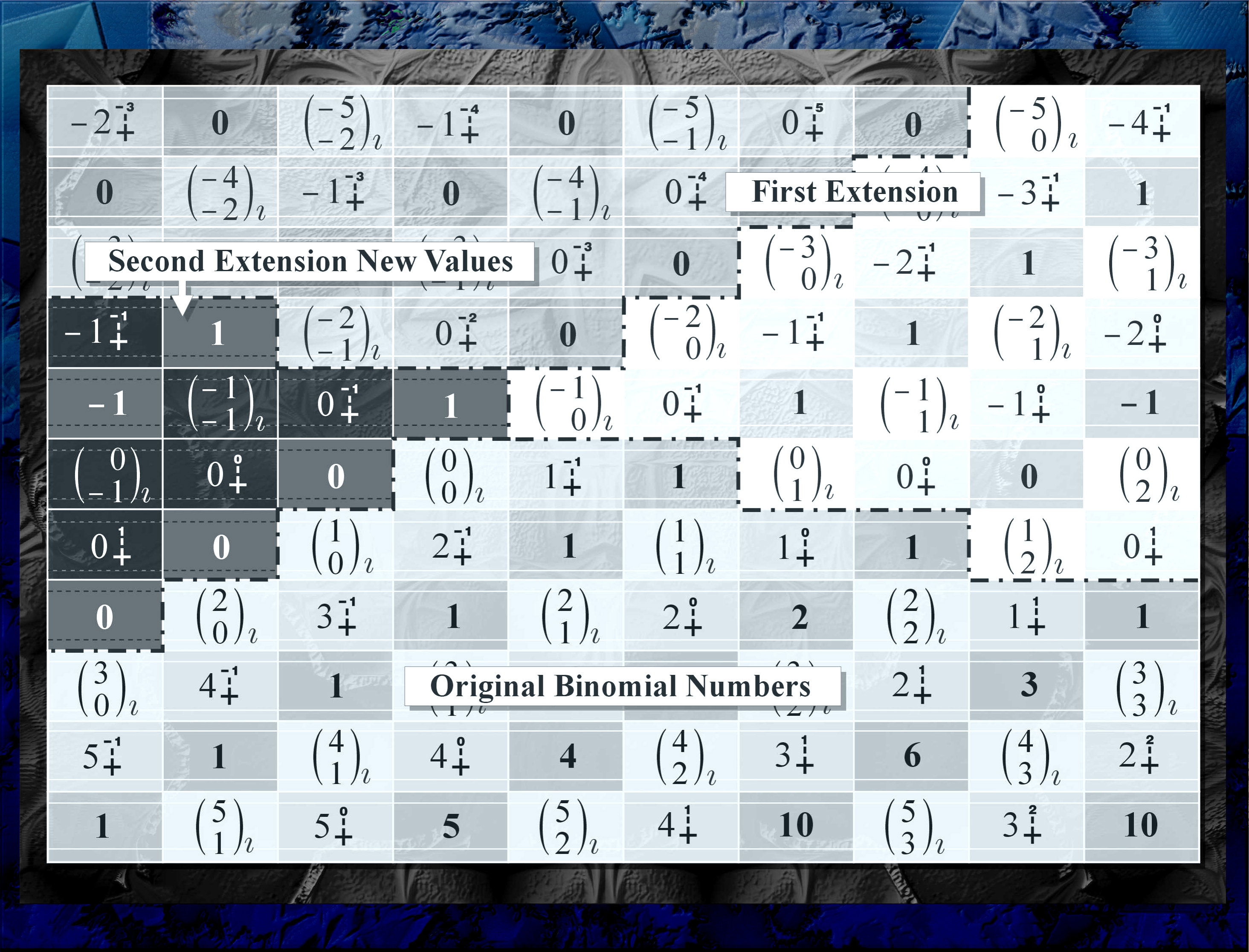
Different types of extensions of the classic binomial coefficients are studied in this article.